Hezekiah
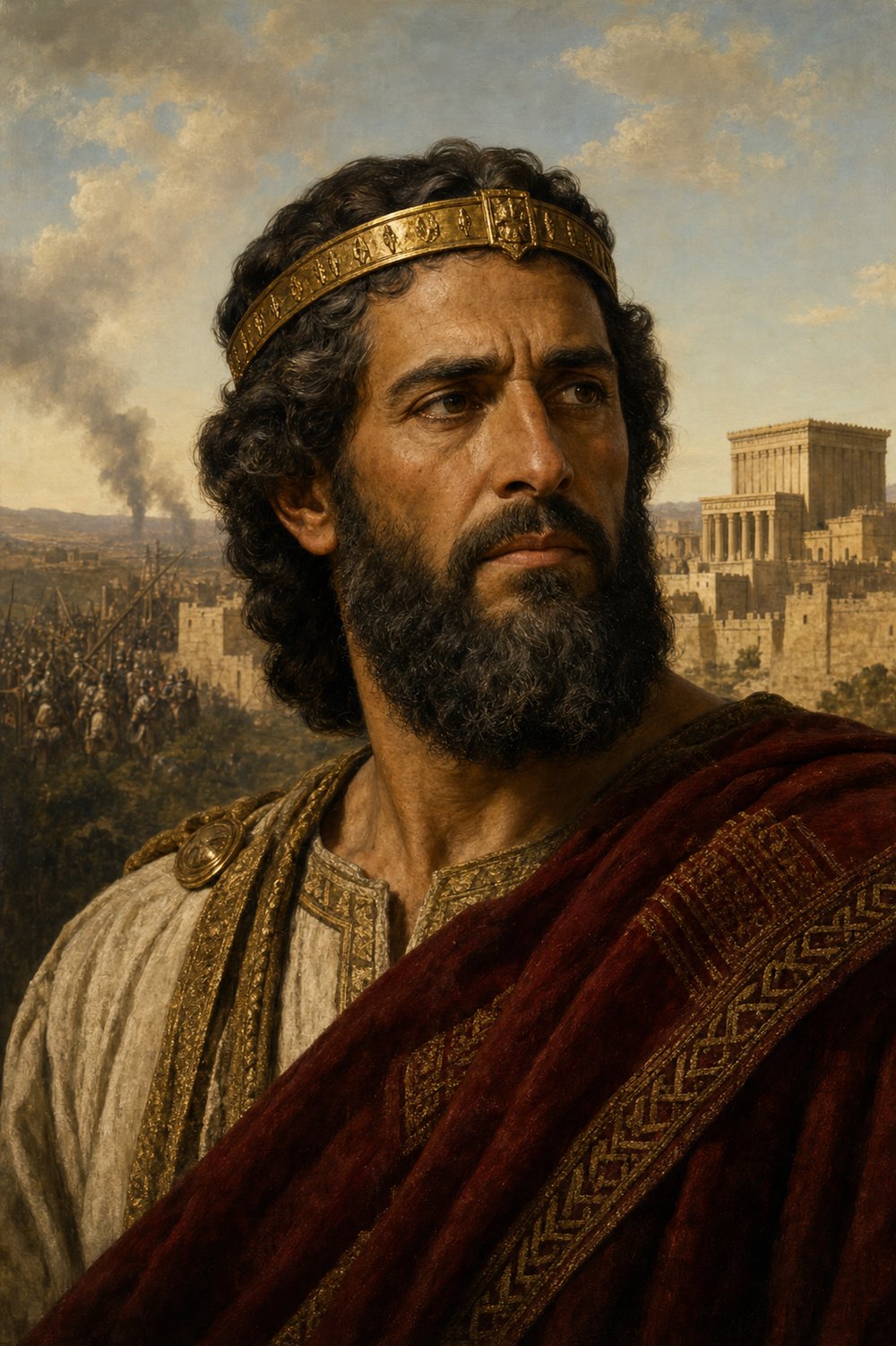
A king of Judah remembered for reform and for survival. He reopened and cleansed the temple his father Ahaz had shut, restored the Passover and invited even the remnant of the northern tribes, and broke up the high places — including the bronze serpent Moses had made, which had become an object of worship. When Sennacherib of Assyria took the fortified cities and besieged Jerusalem, Hezekiah spread the Assyrian letter before the Lord and was answered through Isaiah; the siege lifted. He also cut the tunnel that brought the Gihon spring inside the walls, still walkable today, and its inscription survives.
What we know — and how we know it
 This image was produced by me, David Castor (user:dcastor). The pictures I submit to the Wikipedia Project are released to the public domain. This gives you the right to use them in any way you like, — Public domain (via Wikimedia Commons)
ArchaeologySennacherib's Prism records the Assyrian king shutting Hezekiah in Jerusalem 'like a bird in a cage' — matching the biblical siege from the other side.
This image was produced by me, David Castor (user:dcastor). The pictures I submit to the Wikipedia Project are released to the public domain. This gives you the right to use them in any way you like, — Public domain (via Wikimedia Commons)
ArchaeologySennacherib's Prism records the Assyrian king shutting Hezekiah in Jerusalem 'like a bird in a cage' — matching the biblical siege from the other side.
 Wikikati — Public domain (via Wikimedia Commons)
ArchaeologyHezekiah's Tunnel and its Siloam Inscription still run beneath Jerusalem, the water channel he cut to withstand the siege.
Wikikati — Public domain (via Wikimedia Commons)
ArchaeologyHezekiah's Tunnel and its Siloam Inscription still run beneath Jerusalem, the water channel he cut to withstand the siege.
Where in scripture
2 KingsHe trusted in Yahweh, the God of Israel; so that after him was no one like him among all the kings of Judah, nor among them that were before him.
2 Kings 18:5 — Trusted in the Lord
That night, Yahweh’s angel went out, and struck one hundred eighty-five thousand in the camp of the Assyrians. When men arose early in the morning, behold, these were all dead bodies.
2 Kings 19:35 — Jerusalem delivered
Scripture quotations are from the World English Bible, a public-domain translation.
Family
In their own words — 9 recorded sayings
“And Hezekiah, king of Judah, sent to Lachish, to the king of Assyria, saying, I have done wrong; give up attacking me, and whatever you put on me I will undergo. And the payment he was to make was fixed by the king of Assyria at three hundred talents of silver and thirty talents of gold.” — 2 Kings 18:14
“But the people kept quiet and gave him no answer: for the king's order was, Give him no answer.” — 2 Kings 18:36
“And Hezekiah made his prayer to the Lord, saying, O Lord, the God of Israel, seated between the winged ones, you only are the God of all the kingdoms of the earth; you have made heaven and earth. Let your ear be turned to us, O Lord, and let your eyes be open, O Lord, and see; take note of all the words of Sennacherib who has sent men to say evil against the living God. Truly, O Lord, the kings of Assyria have made waste the nations and their lands, And have given their gods to the fire; for they were no gods, but wood and stone, the work of men's hands; so they have given them to destruction.” — 2 Kings 19:15-19
“O Lord, keep in mind how I have been true to you with all my heart, and have done what is good in your eyes. And Hezekiah gave way to bitter weeping.” — 2 Kings 20:3
“And Hezekiah said to Isaiah, What is to be the sign that the Lord will make me well, and that I will go up to the house of the Lord on the third day?” — 2 Kings 20:8
“And Hezekiah said in answer, It is a simple thing for the shade to go forward; but let it go back ten degrees.” — 2 Kings 20:10
“Then Isaiah the prophet came to King Hezekiah and said to him, What did these men say and where did they come from? And Hezekiah said, They came from a far country, even from Babylon.” — 2 Kings 20:14
“And he said, What have they seen in your house? And Hezekiah said in answer, They saw everything in my house: there is nothing among my stores which I did not let them see.” — 2 Kings 20:15
…and 1 more recorded sayings.
Speaker attribution: Clear Bible MACULA (CC BY 4.0). Wording: Bible in Basic English (public domain).
Events
Places in their life

Photo: Godot13 — CC BY-SA 4.0 (via Wikimedia Commons)
In art


