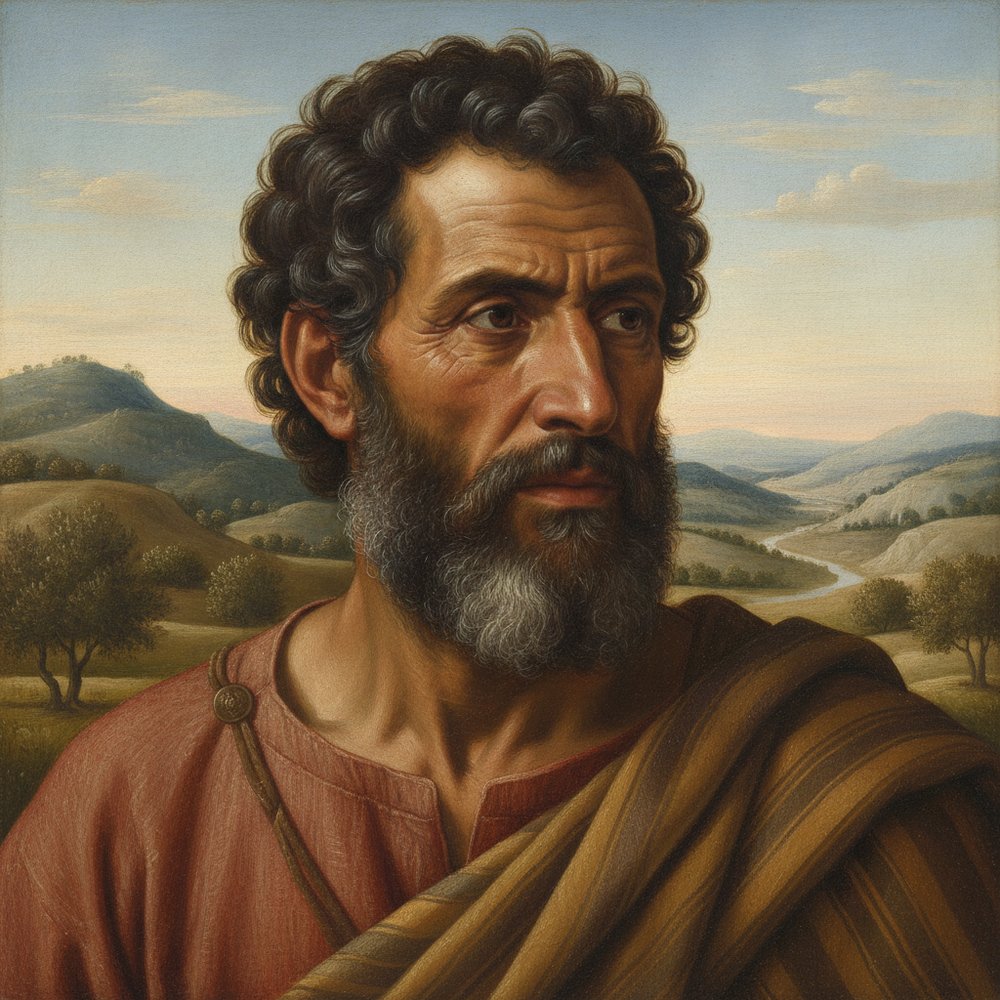
Illustration created for this project.
Elkanah
What we know — and how we know it
Bible — stated in scripture (with verse) · 2
Ancient writers — non-biblical testimony · 1
Scholarly — supported scholarly belief · 1
Family & lineage
Tribe & people
Life, role & deeds
 Scan by NYPL — Public domain (via Wikimedia Commons)
Ancient writersThe Jewish historian Josephus recounts the story of Elkanah, his two wives Hannah and Peninnah, and the birth of Samuel, though his account is a first-century retelling of the biblical narrative rather than independent evidence.
Scan by NYPL — Public domain (via Wikimedia Commons)
Ancient writersThe Jewish historian Josephus recounts the story of Elkanah, his two wives Hannah and Peninnah, and the birth of Samuel, though his account is a first-century retelling of the biblical narrative rather than independent evidence.
Josephus, Antiquities of the Jews 5.342–347 (Niese) = 5.10.2 (Whiston), recounting Elkanah, Hannah and Peninnah, and Samuel's birth; Loeb Classical Library vol. V (Antiquities 5–8), trans. H. St. J. Thackeray & Ralph Marcus, 1934; a first-century retelling of 1 Samuel 1, not independent evidence.
Name & titles
ScholarlyThe Hebrew name Elkanah (Elqanah) combines the divine element El (God) with the verbal root qanah, so it is generally rendered God has created or God has acquired/possessed, the same root behind Eve's naming of Cain in Genesis 4:1.
Standard Hebrew onomastic analysis of the elements El + q-n-h; cf. lexica such as HALOT and BDB.
Where in scripture
1 SamuelThis man went up out of his city from year to year to worship and to sacrifice to Yahweh of Armies in Shiloh. The two sons of Eli, Hophni and Phinehas, priests to Yahweh, were there.
1 Samuel 1:3 — Worships at Shiloh
Scripture quotations are from the World English Bible, a public-domain translation.
Family
In their own words — 2 recorded sayings
“Then her husband Elkanah said to her, Hannah, why are you weeping? and why are you taking no food? why is your heart troubled? am I not more to you than ten sons?” — 1 Samuel 1:8
“And her husband Elkanah said to her, Do whatever seems right to you, but not till you have taken him from the breast; only may the Lord do as he has said. So the woman, waiting there, gave her son milk till he was old enough to be taken from the breast.” — 1 Samuel 1:23
Speaker attribution: Clear Bible MACULA (CC BY 4.0). Wording: Bible in Basic English (public domain).
In art


