
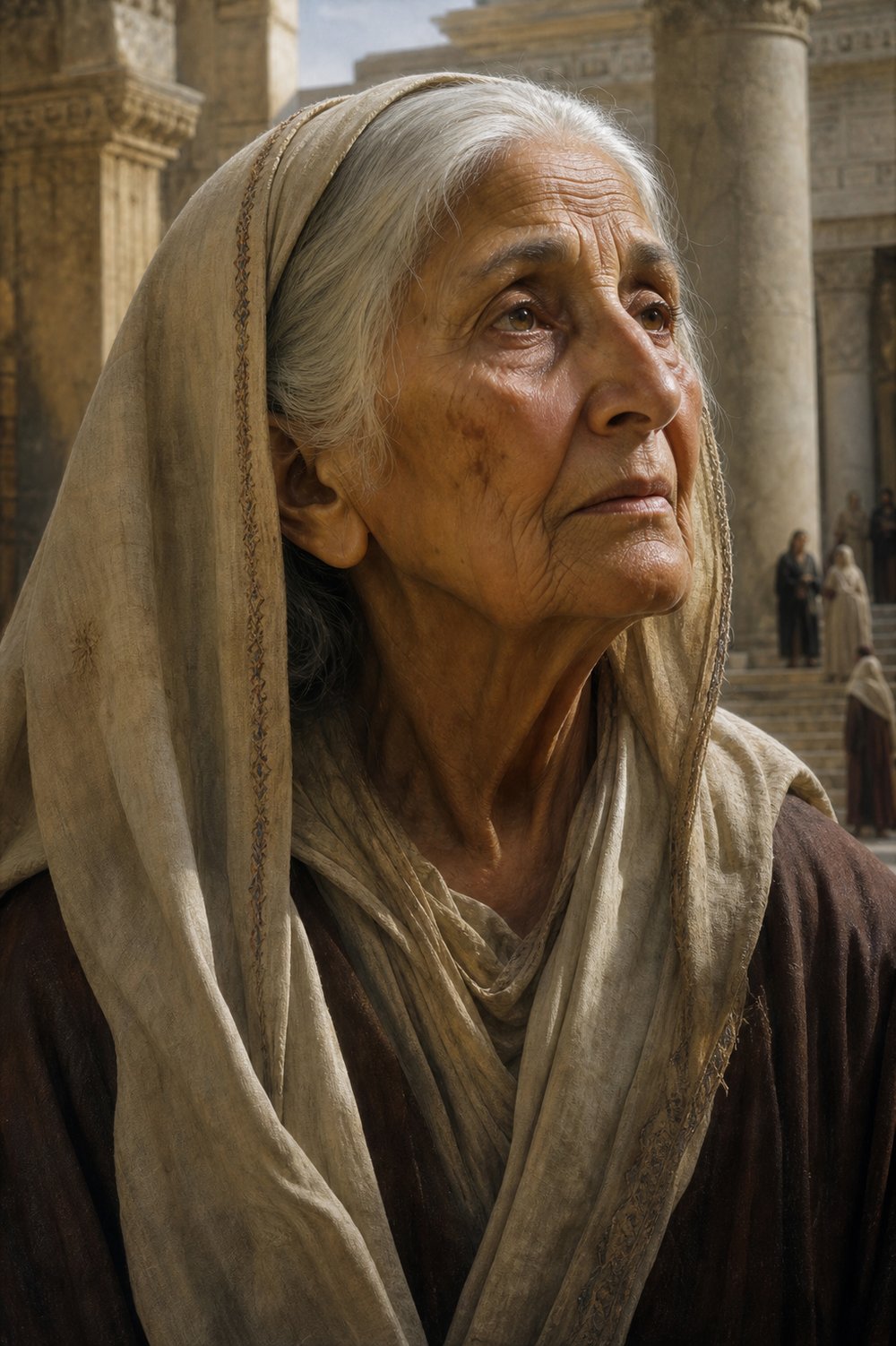
Illustration created for this project.


Anna
An aged widow and prophetess who worshipped in the Temple and spoke of the child Jesus to all awaiting redemption.
What we know — and how we know it
Bible — stated in scripture (with verse) · 3
Scholarly — supported scholarly belief · 2
Origin & birthplace
Family & lineage
Tribe & people
ScholarlyLuke specifies that Anna, daughter of Phanuel, was "of the tribe of Asher," one of the northern tribes usually thought to have lost its distinct identity after the Assyrian conquest. Scholars note this detail as evidence that memory of northern-tribal descent persisted into the first century, whether as genuine genealogical tradition or as a literary marker of Israel's hoped-for restoration.
Scholarly discussion of Second Temple tribal identity; Asher is a northern tribe, making the explicit lineage notice historically noteworthy.
Name & titles
ScholarlyAnna is the Greek form of the Hebrew name Hannah, "grace" or "favor" (from ḥanan, "to be gracious"), the same name borne by the mother of Samuel. The choice is apt for a figure Luke presents devoted to the temple and awaiting redemption.
Onomastic: Hebrew חַנָּה (Ḥannah) from the root ḥ-n-n; Greek Ἅννα.
Where in scripture
LukeThere was one Anna, a prophetess, the daughter of Phanuel, of the tribe of Asher (she was of a great age, having lived with a husband seven years from her virginity,
Luke 2:36
Coming up at that very hour, she gave thanks to the Lord, and spoke of him to all those who were looking for redemption in Jerusalem.
Luke 2:38 — Gives thanks for the child
Scripture quotations are from the World English Bible, a public-domain translation.
Family
Places in their life

Photo: Godot13 — CC BY-SA 4.0 (via Wikimedia Commons)
In art


