
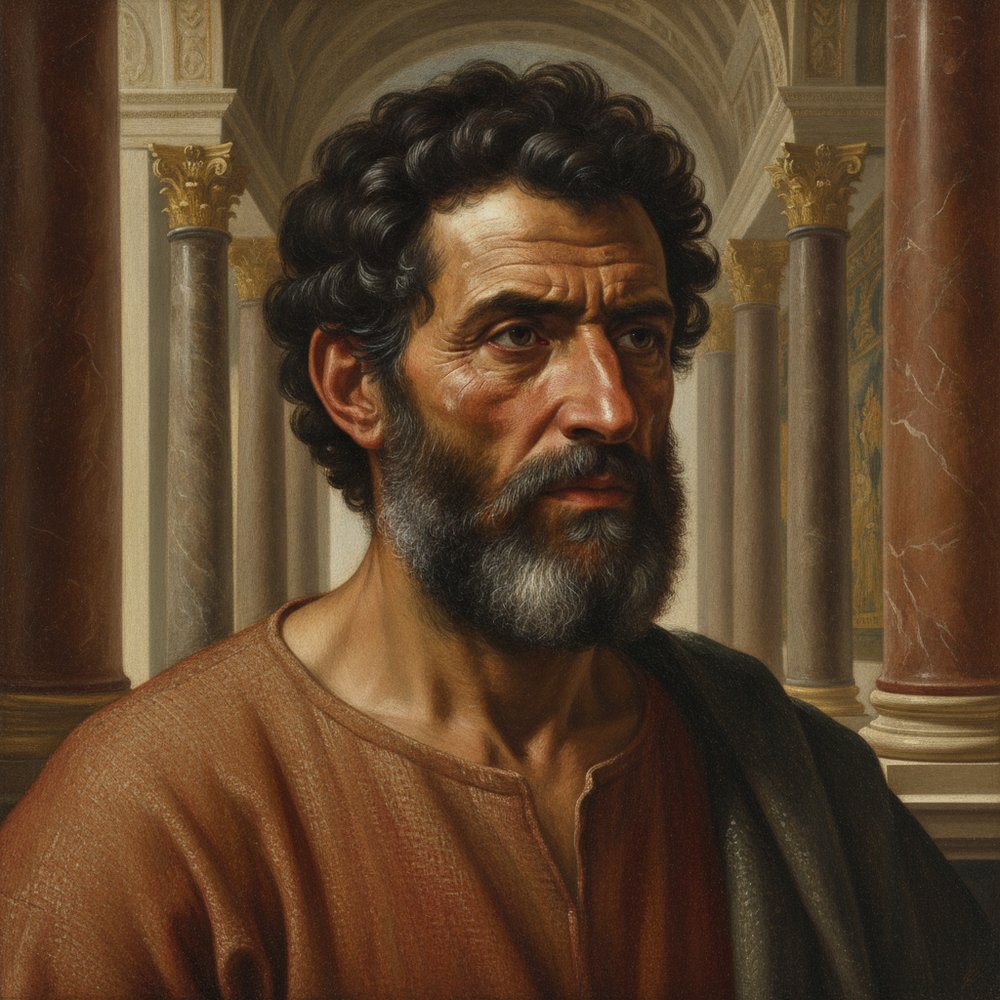



Gehazi
The servant of Elisha, present through much of his master's ministry — turning away the Shunammite woman before Elisha received her, and sent ahead with the prophet's staff to lay on her dead son. His end came after Naaman was healed: Elisha had refused all payment, so Gehazi ran after the Syrian and invented a story about two visiting prophets to obtain silver and clothing, hiding them in the house. Elisha asked whether this was the time to accept money, and Naaman's leprosy clung to Gehazi and his descendants.
What we know — and how we know it
 Scan by NYPL — Public domain (via Wikimedia Commons)
Ancient writersJosephus retells the episode of Naaman's cure and Gehazi's secret extortion of gifts, followed by his affliction with leprosy, in his Jewish Antiquities. This is a first-century paraphrase of 2 Kings rather than independent attestation.
Scan by NYPL — Public domain (via Wikimedia Commons)
Ancient writersJosephus retells the episode of Naaman's cure and Gehazi's secret extortion of gifts, followed by his affliction with leprosy, in his Jewish Antiquities. This is a first-century paraphrase of 2 Kings rather than independent attestation.
Where in scripture
2 KingsHe said to Gehazi his servant, “Call this Shunammite.” When he had called her, she stood before him.
2 Kings 4:12
But Gehazi the servant of Elisha the man of God, said, “Behold, my master has spared this Naaman the Syrian, in not receiving at his hands that which he brought. As Yahweh lives, I will run after him, and take something from him.”
2 Kings 5:20
So Gehazi followed after Naaman. When Naaman saw one running after him, he came down from the chariot to meet him, and said, “Is all well?”
2 Kings 5:21
But he went in, and stood before his master. Elisha said to him, “Where did you come from, Gehazi?” He said, “Your servant went nowhere.”
2 Kings 5:25
Therefore the leprosy of Naaman will cling to you and to your offspring forever.” He went out from his presence a leper, as white as snow.
2 Kings 5:27 — The leprosy clings to him
Now the king was talking with Gehazi the servant of the man of God, saying, “Please tell me all the great things that Elisha has done.”
2 Kings 8:4
As he was telling the king how he had restored to life him who was dead, behold, the woman, whose son he had restored to life, begged the king for her house and for her land. Gehazi said, “My lord, O king, this is the woman, and this is her son, whom Elisha restored to life.”
2 Kings 8:5
Scripture quotations are from the World English Bible, a public-domain translation.
In their own words — 7 recorded sayings
“So he said, What then is to be done for her? And Gehazi made answer, Still there is this, she has no son and her husband is old.” — 2 Kings 4:14
“And Gehazi went on before them and put the stick on the child's face; but there was no voice, and no one gave attention. So he went back, and meeting him gave him the news, saying, The child is not awake.” — 2 Kings 4:31
“But Gehazi, the servant of Elisha, the man of God, said, Now my master has taken nothing from Naaman, this Aramaean, of what he would have given him: by the living Lord, I will go after him and get something from him.” — 2 Kings 5:20
“And he said, All is well: but my master has sent me, saying, Even now, two young men of the sons of the prophets have come to me from the hill-country of Ephraim; will you give me a talent of silver and two changes of clothing for them?” — 2 Kings 5:22
“Then he came in and took his place before his master. And Elisha said to him, Where have you come from, Gehazi? And he said, Your servant went nowhere.” — 2 Kings 5:25
“Now the servant of the man of God, having got up early and gone out, saw an army with horses and carriages of war all round the town. And the servant said to him, O my master, what are we to do?” — 2 Kings 6:15
“And while he was giving the king the story of how Elisha had given life to the dead, the woman whose son had come back to life came to the king with a request for her house and her land. And Gehazi said, My lord king, this is the woman and this is her son, whose life Elisha gave back to him.” — 2 Kings 8:5
Speaker attribution: Clear Bible MACULA (CC BY 4.0). Wording: Bible in Basic English (public domain).
In art


