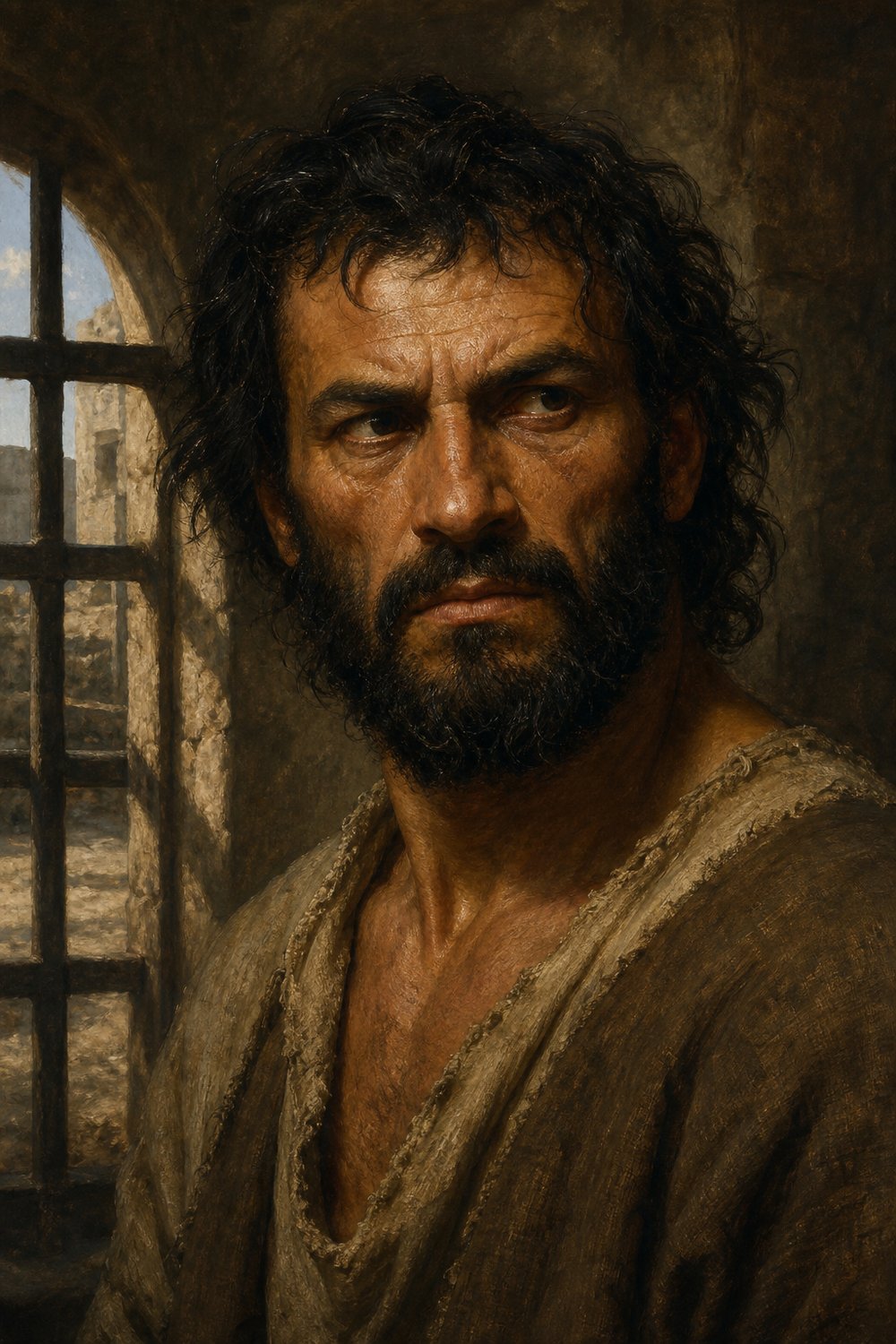
A prisoner held at the time of Jesus's trial, described as a notorious criminal who had committed murder in an insurrection. Following the custom of releasing a prisoner at the feast, Pilate offered the crowd a choice between Barabbas and Jesus, expecting them to ask for Jesus; stirred up by the chief priests they called for Barabbas. He is a figure of a few verses only, yet the exchange — the guilty man freed and the innocent condemned in his place — has been read ever since as a picture of the substitution at the heart of the gospel.
ScholarlyThe name Barabbas is the Aramaic patronymic Bar-Abba, 'son of the father' (bar = son, abba = father); the sense sharpens the Gospel scene in which the crowd chooses this 'son of the father' over Jesus.
Aramaic onomastic analysis of bar-abba; standard commentary observation.
Ancient writersA number of manuscripts give the prisoner the fuller name 'Jesus Barabbas,' and the third-century writer Origen records that copies in his day read this way, though he judged the reading troubling; the variant survives in the Caesarean text and family 1 witnesses at Matthew 27:16-17.
Origen, Commentary on Matthew, scholion on Matt 27:16-17, preserving the reading 'Iesoun ton Barabban'; variant attested in Codex Koridethi (Theta, 038) and family 1; B. M. Metzger, A Textual Commentary on the Greek New Testament, 2nd ed. (Stuttgart: UBS/Deutsche Bibelgesellschaft, 1994), ad Matt 27:16-17.