The Baptism of Jesus
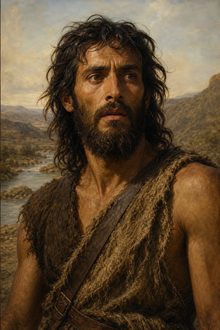
John is preaching in the wilderness in camel's hair and a leather belt, eating locusts and wild honey, and baptising in the Jordan for repentance. Crowds come out to him, and when he sees the religious authorities among them he calls them a brood of vipers and tells them not to rely on descent from Abraham.
He insists throughout that he is not the one — he is a voice, and the coming one is so much greater that John is not fit to untie his sandals. So when Jesus arrives to be baptised, John tries to prevent it.
The accounts agree on what follows: the heavens opening, the Spirit descending like a dove, and a voice naming Jesus as beloved Son. It is the start of the public ministry, and all four Gospels use it as their point of departure. John the Baptist is independently described by the historian Josephus.
Where in scripture
[1] In those days, John the Baptizer came, preaching in the wilderness of Judea, saying, [2] “Repent, for the Kingdom of Heaven is at hand!” [3] For this is he who was spoken of by Isaiah the prophet, saying, “The voice of one crying in the wilderness, make ready the way of the Lord. Make his paths straight.” [4] Now John himself wore clothing made of camel’s hair, with a leather belt around his waist. His food was locusts and wild honey. [5] Then people from Jerusalem, all of Judea, and all the region around the Jordan went out to him. [6] They were baptized by him in the Jordan, confessing their sins. [7] But when he saw many of the Pharisees and Sadducees coming for his baptism, he said to them, “You offspring of vipers, who warned you to flee from the wrath to come? …
Matthew 3:1–17 — opening verses
[1] The beginning of the Good News of Jesus Christ, the Son of God. [2] As it is written in the prophets, “Behold, I send my messenger before your face, who will prepare your way before you: [3] the voice of one crying in the wilderness, ‘Make ready the way of the Lord! Make his paths straight!’” [4] John came baptizing in the wilderness and preaching the baptism of repentance for forgiveness of sins. [5] All the country of Judea and all those of Jerusalem went out to him. They were baptized by him in the Jordan river, confessing their sins. [6] John was clothed with camel’s hair and a leather belt around his waist. He ate locusts and wild honey. [7] He preached, saying, “After me comes he who is mightier than I, the thong of whose sandals I am not worthy to stoop down and loosen. …
Mark 1:1–11 — opening verses
[1] Now in the fifteenth year of the reign of Tiberius Caesar, Pontius Pilate being governor of Judea, and Herod being tetrarch of Galilee, and his brother Philip tetrarch of the region of Ituraea and Trachonitis, and Lysanias tetrarch of Abilene, [2] in the high priesthood of Annas and Caiaphas, the word of God came to John, the son of Zacharias, in the wilderness. [3] He came into all the region around the Jordan, preaching the baptism of repentance for remission of sins. [4] As it is written in the book of the words of Isaiah the prophet, “The voice of one crying in the wilderness, ‘Make ready the way of the Lord. Make his paths straight. [5] Every valley will be filled. Every mountain and hill will be brought low. The crooked will become straight, and the rough ways smooth. …
Luke 3:1–22 — opening verses
[29] The next day, he saw Jesus coming to him, and said, “Behold, the Lamb of God, who takes away the sin of the world! [30] This is he of whom I said, ‘After me comes a man who is preferred before me, for he was before me.’ [31] I didn’t know him, but for this reason I came baptizing in water: that he would be revealed to Israel.” [32] John testified, saying, “I have seen the Spirit descending like a dove out of heaven, and it remained on him. [33] I didn’t recognize him, but he who sent me to baptize in water, he said to me, ‘On whomever you will see the Spirit descending, and remaining on him, the same is he who baptizes in the Holy Spirit.’ [34] I have seen, and have testified that this is the Son of God.”
John 1:29–34
Scripture quotations are from the World English Bible, a public-domain translation.