The Great Flood
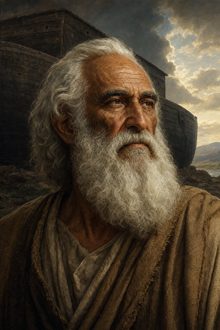
Noah is described as righteous in a generation the text says was filled with violence, and is told to build a vessel to specific dimensions and take his family and breeding pairs of every kind of creature aboard. The rain falls forty days; the waters prevail a hundred and fifty.
The telling is careful about detail — the pitch inside and out, the single window, the dove sent out three times, returning first with nothing, then with an olive leaf, then not at all. When they come out Noah builds an altar, and God undertakes never again to destroy all life by water, setting the rainbow in the cloud as the sign of it.
The covenant is made with every living creature, not only with people. Flood traditions are widespread in ancient Mesopotamian literature, and the Genesis account is distinguished less by the disaster than by its ending in a promise.
Where in scripture
[9] This is the history of the generations of Noah: Noah was a righteous man, blameless among the people of his time. Noah walked with God. [10] Noah became the father of three sons: Shem, Ham, and Japheth. [11] The earth was corrupt before God, and the earth was filled with violence. [12] God saw the earth, and saw that it was corrupt, for all flesh had corrupted their way on the earth. [13] God said to Noah, “I will bring an end to all flesh, for the earth is filled with violence through them. Behold, I will destroy them and the earth. [14] Make a ship of gopher wood. You shall make rooms in the ship, and shall seal it inside and outside with pitch. …
Genesis 6:9–22 — opening verses
[1] Yahweh said to Noah, “Come with all of your household into the ship, for I have seen your righteousness before me in this generation. [2] You shall take seven pairs of every clean animal with you, the male and his female. Of the animals that are not clean, take two, the male and his female. [3] Also of the birds of the sky, seven and seven, male and female, to keep seed alive on the surface of all the earth. [4] In seven days, I will cause it to rain on the earth for forty days and forty nights. I will destroy every living thing that I have made from the surface of the ground.” [5] Noah did everything that Yahweh commanded him. [6] Noah was six hundred years old when the flood of waters came on the earth. …
Genesis 7:1–24 — opening verses
[1] God remembered Noah, all the animals, and all the livestock that were with him in the ship; and God made a wind to pass over the earth. The waters subsided. [2] The deep’s fountains and the sky’s windows were also stopped, and the rain from the sky was restrained. [3] The waters continually receded from the earth. After the end of one hundred fifty days the waters decreased. [4] The ship rested in the seventh month, on the seventeenth day of the month, on Ararat’s mountains. [5] The waters receded continually until the tenth month. In the tenth month, on the first day of the month, the tops of the mountains were visible. [6] At the end of forty days, Noah opened the window of the ship which he had made, …
Genesis 8:1–22 — opening verses
[1] God blessed Noah and his sons, and said to them, “Be fruitful, multiply, and replenish the earth. [2] The fear of you and the dread of you will be on every animal of the earth, and on every bird of the sky. Everything that moves along the ground, and all the fish of the sea, are delivered into your hand. [3] Every moving thing that lives will be food for you. As I gave you the green herb, I have given everything to you. [4] But flesh with its life, that is, its blood, you shall not eat. [5] I will surely require your life’s blood. At the hand of every animal I will require it. At the hand of man, even at the hand of every man’s brother, I will require the life of man. [6] Whoever sheds man’s blood, his blood will be shed by man, for God made man in his own image. …
Genesis 9:1–17 — opening verses
Scripture quotations are from the World English Bible, a public-domain translation.